
Volatility Capture
An all-weather investment approach, combining the benefits of option writing, with strategies designed to protect downside risk
Our Strategy
Our Strategy
is Different
- Consistent – Positive results in over 95%* of all live trading months.
- Uncorrelated – Positive results in over 70%* of down-months for major U.S. indices such as the NASDAQ and Dow Jones Industrial Average (DJIA) since 2021.
- Directionally Agnostic – Maintains minimal directional exposure to broad global indices.
- Repeatable & Systematic – A fully rules-based, algorithmic framework that eliminates emotional decision-making.
- Liquid – Trades exclusively in broad-market, highly liquid, U.S. listed index options and futures, enabling efficient execution and daily liquidity.
Systematic Process
Our strategy employs a repeatable process that combines put spreads, short puts, and volatility options designed to manage exposure.
The portfolio invests in complex index option positions in an attempt to produce positive returns in rising, sideways, and declining markets. Exposure to volatility derivatives seeks to offset downside risk in severely declining markets.
The Rising Edge
Option values are mathematically driven. Option prices can be emotionally driven.
While we rely heavily on quantitative analysis in our trade process, we also emphasize behavioral factors in trade construction and risk management.
Being an active participant in nearly every market condition imaginable has taught us the importance of remaining dispassionate and “sticking to the plan”.
Volatility Capture
Investment Programs
STRATEGY HIGHLIGHTS
- RCG focuses on building a globally diversified options portfolio designed to generate consistent, modest returns with controlled risk exposure.
- The strategy aims to maintain flexible positioning so that broad market movements in major US indices—such as NASDAQ and Dow Jones—do not materially impact portfolio performance.
- Our primary investment instruments are index options (approximately 95%), complemented by a small allocation (around 5%) in futures, commodities, and currency trades linked to global markets.
- Our return objective is to target a 25%–30% gross annualized return across most market environments, subject to volatility and global macro conditions.
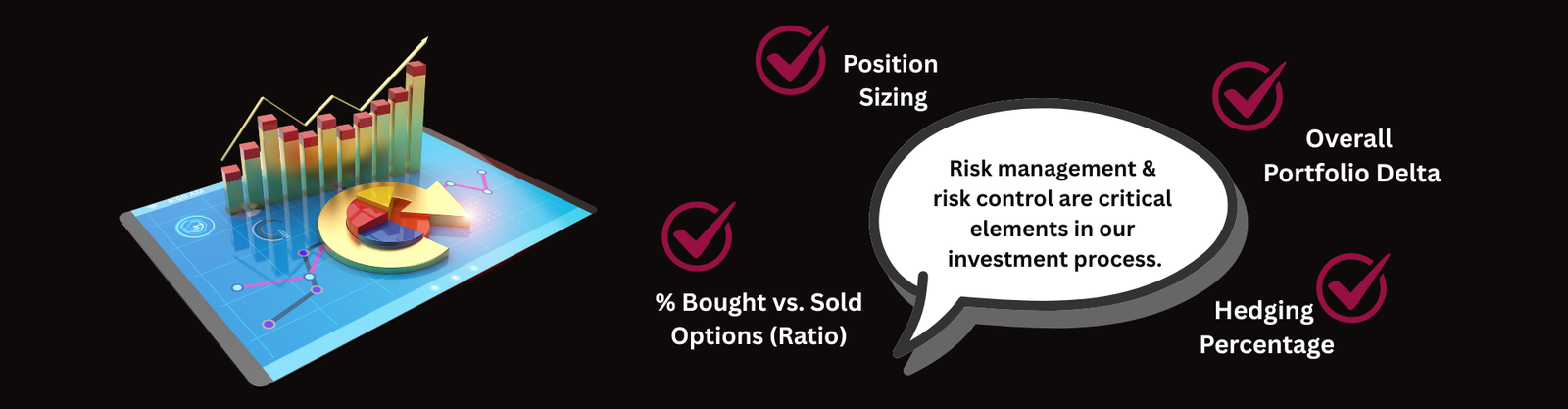
- Position adjustments are executed based on the accumulated delta of the overall portfolio, ensuring disciplined risk management and exposure control.
- Additional global factors incorporated into our decision-making include: seasonal market tendencies, USD value relative to major global currencies, commodity movements such as oil and gold, global index trends, geopolitical developments, and other macroeconomic indicators.
Volatility Capture
Position Hedging
Fundamental and Technical Analysis
Extensive Risk Analysis & Management
Market Intelligence & Trade Construction
Manager Driven Position Hedging
FUNDAMENTAL AND TECHNICAL ANALYSIS |
Market expectations over the short term (3–5 weeks) - Assessment of short-term expectations in major global indices such as NASDAQ and Dow Jones, focusing on directional bias, volatility trends, and macro catalysts. Market option pricing near term (Up to 2 months) - Evaluation of global index option pricing behavior—including implied volatility, skew, and premium movement—in NASDAQ and DJIA options over the near-term horizon. Historical option/market pricing (10–15 years) - Long-term study of price cycles, volatility regimes, correction patterns, and derivatives behavior in NASDAQ and Dow Jones over the past decade-plus. This multi-layered analysis determines the overall portfolio size and Delta positioning. INVESTMENT BEGINS Dynamic Position Adjustments Positions are adjusted continuously based on evolving global market conditions, volatility shifts, interest rate expectations, and macroeconomic triggers influencing NASDAQ, Dow Jones, and global risk assets. Continuous Monitoring Constant portfolio and position monitoring enables the strategy to capture optimal returns while maintaining disciplined global risk management. |
INFORMATION USED TO INFLUENCE INVESTMENT DECISIONS |
Historical pricing patterns of the underlying assets and/or equity indexes, primarily NASDAQ and Dow Jones Industrial Average (DJIA). |
Comparison of historical volatility to implied volatility. |
Analysis of different volatility skews. |
The liquidity of an underlying asset and its related options. |
During macro events that affect the portfolio, monitoring and hedging of the portfolio is performed on a continual basis. If required we utilize currencies, index futures and other commodities for this purpose. |
The entire investment portfolio is monitored by consistently calculating the expected return using statistical option probabilities and estimated monthly premiums received. |
Volatility Capture
Analysis & Risk Management
Where We Operate